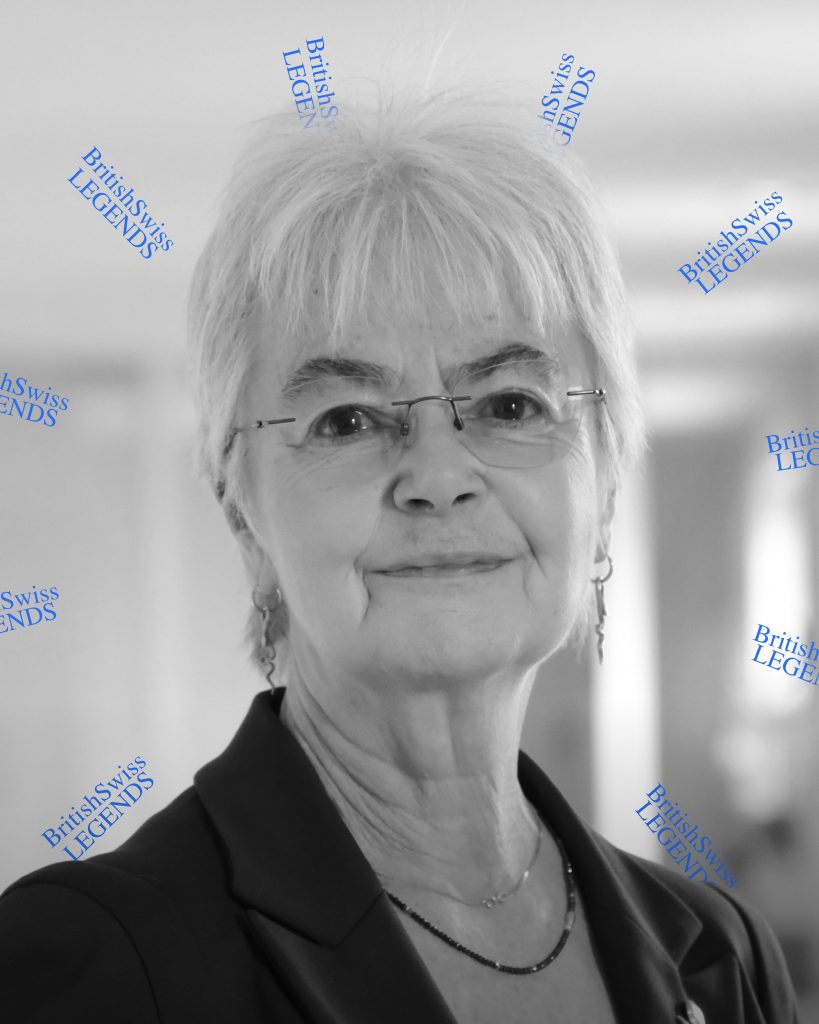
Even among the figures who make up the British-Swiss Legends, there are few who can point to a more substantial academic and teaching legacy than Professor Emerita Catherine Housecroft.
The now Professor Emerita of Chemistry at the University of Basel has led a career defined by intellectual rigour, scientific discovery and education.
Not only has she led the way in her field, but she has also educated, nurtured and inspired generations of budding chemists and scientists across the UK, Switzerland and beyond.
Great teaching creates great teachers
Raised in Bradford, Professor Housecroft explained that she had always been interested in science, conducting her first chemistry experiments in the kitchen of her family home. In the same way that her own teaching has shaped her legacy, her development was aided by “excellent science teachers,” she told us.
An early fascination with chemical change, colour and crystals led her to study chemistry at the University of Durham, where she earned both her bachelor’s and doctoral degrees. However, instead of plunging headfirst into academia, she then spent four years teaching at a high school in Oxford. It was here that she concluded on the path she wanted to take. “I love teaching, but I really wanted to combine it with research,” she explained.
Tenures as a post-doctoral researcher at the University of Notre Dame and an assistant professorship at the University of New Hampshire preceded a lectureship at the University of Cambridge. It was here that she was able to establish her own research programme in organometallic and theoretical chemistry.
Moving to Basel: New opportunities and challenges
A pivotal chapter came in 1993, when Housecroft and her husband (Edwin Constable, a fellow chemist) decided to move to Basel. “The research opportunities and the financing of research in Switzerland were very attractive for us… we thought that we would be able to develop a much larger research profile in Switzerland than we could do in the UK,” she explained.
It was not a simple transition: academic structures in the UK and Switzerland were different, and “learning German and Swiss German” was not easy. However, they soon found a place that they can now call their long-term home. “We really feel we belong here,” she added.
It was in Basel that Professor Housecroft solidified her legacy. In terms of research, she would pivot towards the use of inorganic chemistry in sustainable energy production. These included developing new compounds used to harvest solar energy or for incorporation into energy-efficient lighting devices, among many other research projects.
In total, Housecroft has authored over 600 research publications during her career, pushing her field through consistent curiosity and investigation.
At its peak, Housecroft’s research group (which she ran jointly with her husband) stood at around 25 people. Over the course of four decades, she and her husband would teach, guide and mentor over 100 PhD students.
“I like to think that I have helped to nurture the careers of the PhD candidates… You need to know at what point to step back and let them become independent.”
Accessibility is the key to good teaching
Her teaching style focuses on making complex science as accessible as possible.
“Always be prepared to communicate to all levels of society, not just the narrow band you might meet in academia,” she explained.
Students in Basel are not the only ones to benefit from Housecroft’s expertise, with the professor also authoring one of the standard textbooks for inorganic chemistry. Now in its sixth edition, it was one of the first in its field to become fully interactive and digital. Spanning 1,300 pages and translated into seven languages, it remains a global reference point for the field.
Take opportunities as they come
Looking back, Housecroft said that she “never planned [her] career. I tend to take opportunities as they come.” Together with her husband, Housecroft has taught and mentored generations of chemists from the UK, Switzerland and across the world.
“I would say that where collaboration works best is actually encouraging movement of people between countries,” she reflected, adding that many British students have earned PhDs in the UK and Switzerland with her guidance.
Today, Housecroft remains the Editor-in-Chief of the Swiss Chemical Society’s journal Chimia, a position she has held for 6 years. The journal remains a strong supporter of chemical research in Switzerland, with Housecroft taking a particular interest in education. She also has a passion and respect for wildlife, and is a keen photographer, using images of the natural world to connect to chemistry and spark curiosity in young people.
Taken together, Professor Housecroft’s career is epitomised by not just research, but a desire to pass on the knowledge and expertise of today to the scientists and leaders of tomorrow. From Bradford to Basel, from lecture theatres to laboratories, and from printed pages to fully interactive textbooks, she has consistently combined intellectual ambition with a desire to share her knowledge.
Her legacy lies as much in the hundreds of scientists she has mentored and inspired as in the research she has advanced.