Though the business and trade ties between the United Kingdom and Switzerland are well known, part of the defining basis of the relationship between the two nations remains in medicine. From the lab to the operating table, life science companies and medical experts from both countries continue to work together to push the envelope of innovation.
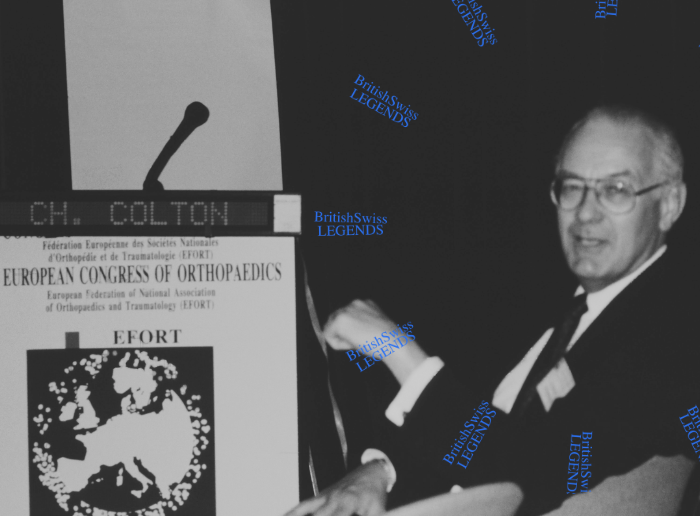
Few individuals symbolise this collaboration more than Professor Chris Colton, the former President of the British Orthopaedic Association and AO Foundation. In a career that would span both nations, Colton was a knowledge bridge, introducing the very latest Swiss-developed treatments to the UK.
What started as a traditional medical career ended with Colton becoming one of the key leaders in medical education, and a series of events where Swiss expertise was used to help the British Royal Family.
Real skeletons and surgical excellence
Born in Nottingham in 1937, Chris Colton was inspired from an early age to study medicine. Speaking to the AO Foundation in 2023, Colton said that “In my first biology lesson at school, at the age of 11 years, I sat next to the lab skeleton, a real one in those days, not plastic. I was immediately fascinated by the bones that had once been the framework of a living person. The homework that evening was to learn the names of as many of the bones as possible, and for the test the next day, I got 100% marks.”
Colton carried that passion into his studies at St Thomas Hospital Medical School in London, becoming a Fellow of the Royal College of Surgeons of England in 1963. In a sign of the explorative spirit and commitment to care that would drive him, upon qualifying as an orthopaedic surgeon (someone who specialises in fixing broken bones), he quickly moved to work in Kano, Northern Nigeria, during the Biafran Civil War.
Colton’s first engagements with Switzerland began in 1967, when he was sent to Chur, to train under AO Founder Martin Allgöwer. At the time, Swiss orthopaedic experts were pioneering new methods of treating broken bones using plates, an innovation that would eventually revolutionise practice around the world.
According to Piet de Boer, former Director of Education at the AO Foundation, the new methods of treatment allowed patients to mobilise their limbs far earlier than previously. This revolution in practice meant that bones healed and patients were able to return to their normal lives faster.
Based on this insight gained in Switzerland, Colton was able to introduce these ideas to the United Kingdom. Together with the British Orthopaedic Association, where he would serve as president from 1995 to 1996, and the AO Foundation, where he would serve as president between 1996 and 1998, he would continue to push the boundaries of both trauma surgery and medical education.
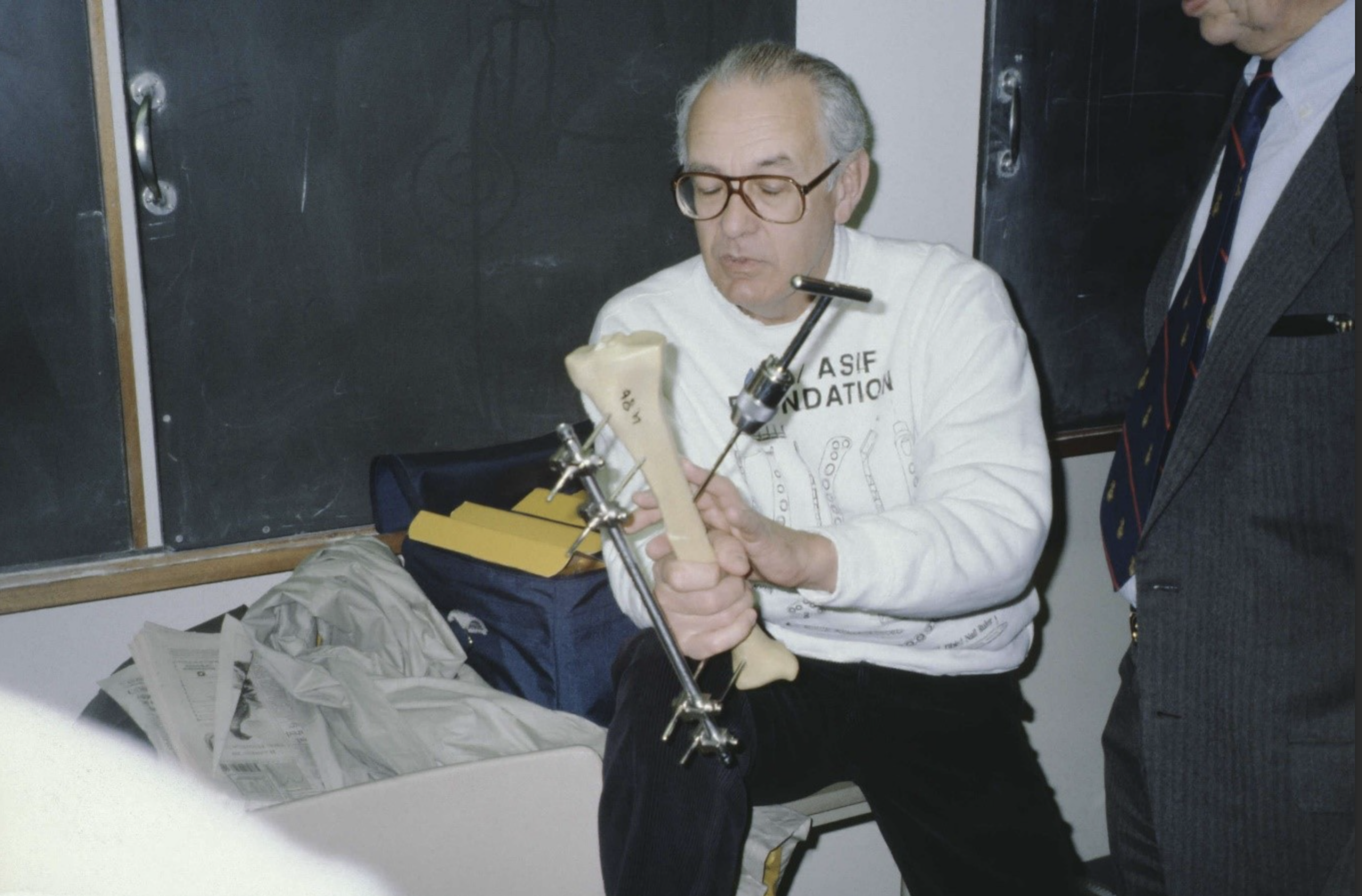
In all, he would author articles in over 70 different journals, and every year since 2011, the Nottingham University Fracture Forum delivers a Chris Colton Trauma Lecture.
Given his focus on post-trauma reconstructive care, Colton became a go-to surgeon for many famous figures and events throughout his career. In 1977, he treated British mountaineer Doug Scott three weeks after he had fractured both his legs and in 1991, he treated motorcycling world champion Ron Haslam. In 1989, he treated several casualties of the Kegworth air disaster. His investigation led to the first research-based definition of a passenger brace position.
Chris Colton and Prince Charles
The best example of Colton’s fusion of Swiss knowledge and British application would occur in 1990. During that year, the then-Prince Charles had suffered a fractured right arm following a polo accident.
At the time, common practice in Charles’ case was not to attempt to fix or graft the fractured bone, and instead to leave it immobile in a cast. In fact, five years before the accident, it had been a specific NHS policy not to try to fix the fracture.However, with Charles’s elbow not improving, the Royal Family reached out to the AO Foundation and the Swiss orthopaedic experts in Chur.
Connections there were strong, given that Swiss doctors had successfully treated Royal Family members when they were caught in an avalanche in Klosters in 1988. During the treatment of Patty Palmer-Tomkinson in Davos, one of the survivors of the avalanche, Charles visited her regularly and was able to see firsthand how Swiss doctors were able to reconstruct her broken bones effectively.
However, officials deemed it more appropriate for a British doctor to perform the procedure in the UK. So it was arranged that Colton would perform the operation to bone graft the future King’s elbow. The operation was a complete success.
Colton then ensured that the expertise that the Swiss had mastered would be made common practice in the UK, improving patient outcomes for hundreds of thousands of people.
Clinical excellence
Chris Colton would pass away in late 2025, ending a star-studded, decades-long career. “We will remember Colton not only for his clinical excellence and leadership but also for his warmth, generosity, and commitment to advancing trauma care globally,” the AO Foundation wrote in his obituary following his passing.
His friend and colleague, Paul Szypryt, said that “He had a huge intellect which he was happy to share. He was never happier than giving a lecture to an appreciative audience.” “His ‘disciples’ have populated many of the major trauma units throughout the UK and beyond,” he concluded.
With so many doctors learning from his techniques worldwide, his impact is as immeasurable as it is immense.