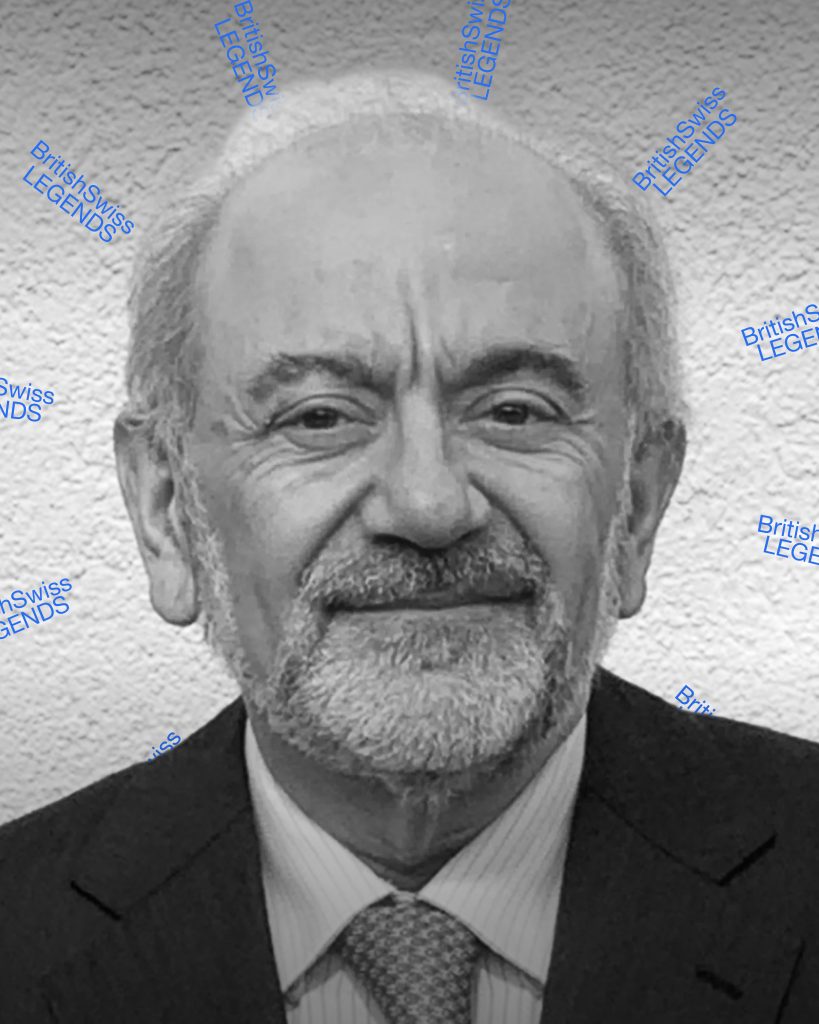
“Business is based on relationships,” Howard Rosen CBE
When talking about individuals who have made big impacts in their careers, there is often a difference between those whose paths followed a straight line and those whose unfolded through a fusion of passion and unexpected opportunity. For Howard Rosen, his journey fits neatly into the latter.
The Swiss-based lawyer has had a far-reaching influence in the United Kingdom, Switzerland, and beyond. Over decades, he has built a solid reputation in law, entrepreneurship, international policy and civic leadership, as well as helped shape the UK-Swiss relationship as we know it today.
Academic excellence and a lucky move to Switzerland
Speaking to us, Rosen remarked that his upward trajectory began after he was granted a scholarship to study at the City of London School. “My parents couldn’t have afforded it,” he noted, but the opportunity “set me on my way” to further academic success at Oxford, where he studied law.
Following graduation, Rosen qualified as an English solicitor, but within a short time, he realised that his ambitions also extended to the corporate sector. He entered the industry, working at a computer leasing company at a time when the field was experiencing rapid growth, giving the young Rosen an early insight into the intersection between law, finance and emerging technologies—an intersection that would shape much of his later career.
It may seem surprising, given the impact he has had in Switzerland, but Rosen’s move to the Alpine nation was more luck than planned. While working as the general counsel for the European finance operations of a U.S. multinational company, the firm announced that its European headquarters would relocate from the United Kingdom.
Three potential destinations were considered: Paris, Monaco, and Zurich. “I was praying that we would go to Zurich,” Rosen recalled, and fortunately for him, that is where they moved.
Switzerland and networks
Rosen recognised that Switzerland offered a unique environment for business: international, pragmatic and deeply embedded in global markets. Over time, Rosen would become an integral part of this ecosystem.
For him, the power of connections and relationships was what truly set the best leaders apart. “Think in terms of networks… and how you build those networks can be really helpful for the way you build your business,” he explained. “Business is based on relationships at the end of the day…You’ve got to be able to look people in the eye and understand how they react to things.”
Despite advances in technology and digital communication, he argued that trust remains the central currency of economic cooperation. Diplomatic conferences, business forums, and official meetings all have their place—but the real work often happens in informal conversations.
In 1989, with financial stability assured, Rosen took a great leap, setting up his own private practice in Zug. His passion for connection and networks paid off, making him and his firm one of the cornerstones of the business and legal landscape of the region. Today, Rosen is a leader in international commercial, corporate, and finance law.
The BSCC and philanthropy
Over his career, Rosen has entwined his work with philanthropy and volunteering, noting that “you don’t wait until you retire to do your good deeds.” “You don’t look at the world just in terms of cash… what thrills you is seeing that you’ve done something and it’s made a difference.”
In the first case, this involved being invited by the International Institute for the Unification of Private Law (UNIDROIT) to organise an industry working group focused on rail finance.
The initiative eventually resulted in the Luxembourg Rail Protocol to the Cape Town Convention. The treaty aims to make it easier for private investors to finance railway rolling stock by creating legal protections for lenders. Though Rosen had initially expected his role to last a few years, it eventually turned into a decades-long commitment helping governments and institutions navigate the legal complexities of treaty adoption—often without financial reward.
Another key part of Rosen’s career was his instrumental leadership of the British-Swiss Chamber of Commerce, gradually moving up in the organisation to the role of President of the Chamber in 1998. Before his tenure, while the BSCC did offer a good forum for business collaboration, it had not achieved its potential as a force for British-Swiss trade.
Through Rosen’s leadership and philosophy that “if you had quality events, people would come,” the chamber would begin to grow its membership, ensuring its survival in the long term. Rosen also successfully refocused the chamber and made it an active voice in the political arena, most notably during his calls to reform Swiss corporate governance regulations in the 2000s.
His efforts were recognised in 2003. In the Queen’s Birthday Honours, Howard Rosen was appointed a Commander of the Order of the British Empire (CBE) for services to British business in Switzerland.
His leadership of the Chamber was based on a deep understanding of both nations and cultures. “I always used to think… that both the British and Swiss have island mentalities,” he said with characteristic humour. “It’s just that the Swiss don’t have a sea.” He added that there is “great warmth” between the two nations, and that his efforts to bolster the relationship between the two were as much a personal passion as it was a professional mission.
Making a difference
Looking back, Rosen is modest about his achievements, stating that “the outcome is more important than the credit for doing it.” “We’re here to make the world a better place. You can’t spend all of your life earning lots of money and then sit back and think, well, what have I really contributed?”
For the next generation of leaders, Rosen concluded that it is all about “giving your time back to the community—that’s the most precious thing you can give.” Throughout his life, Rosen has done far more than most to live by this principle.