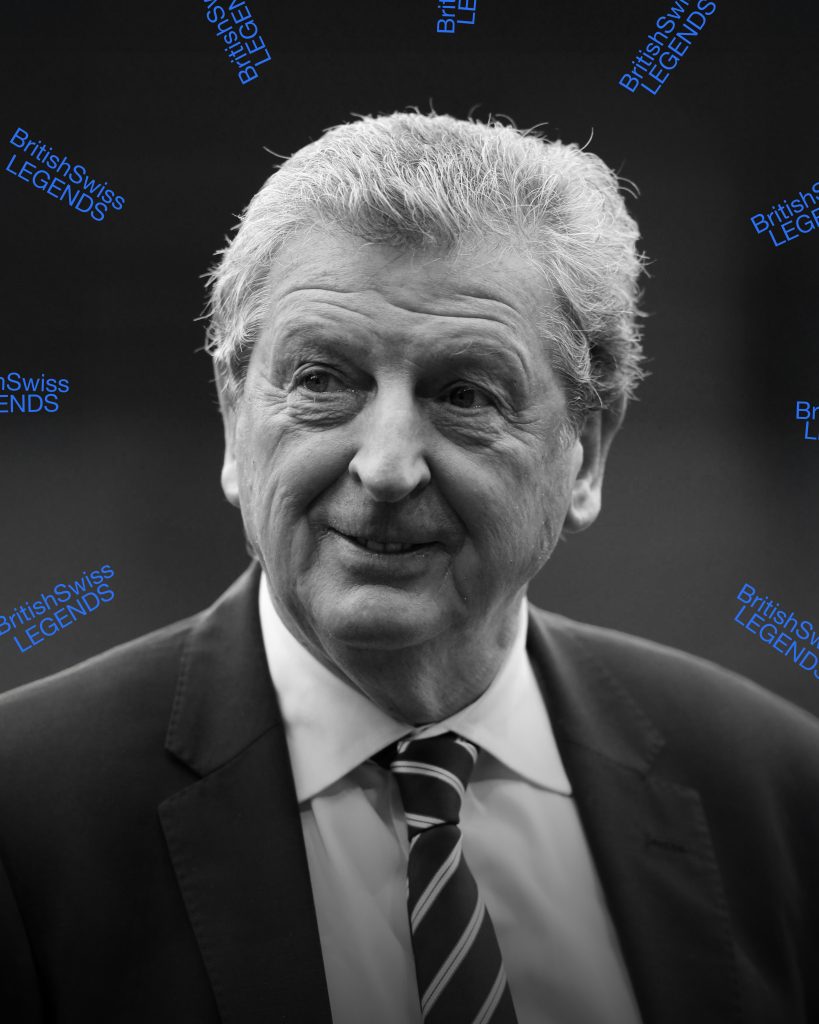
“Learn to speak to people… If you can’t do that, you can’t be a leader,” Roy Hodgson.
When it comes to football managers, most are remembered either for prolific spells at a handful of clubs or as journeymen plying their trade across the sport. With Roy Hodgson, former England and Switzerland manager, you have a coach whose imprint has been felt across the UK, Switzerland and beyond.
Though well-remembered for his spells in charge of England and of major English clubs such as Crystal Palace, Fulham, and Liverpool, a lesser-known part of Hodgson’s wide-ranging career was his profound impact on Swiss football, securing die Nati’s first major tournament appearance in decades.
First forays into management
Born in 1947 in the London Borough of Croydon, Hodgson’s managerial career started far away from the peaks of continental football. After a modest playing career, his big break in management came in the mid-70s, when Bob Houghton, a former friend from his school days who employed Hodgson as assistant manager, recommended he take control of Swedish side Halmstad.
By his own admission, he approached the job “naively”, telling us that he relied too much on his coaching education and was not yet versed in the strict man-management that would come to form an integral part of his coaching style.
Nevertheless, his first foray into management led to success, with Halmstad winning the league championship in 1976 and 1979. He credits his success to two things: “You need some wins,” and “you’ve got to create an environment that people can relate to and take part in.”
European powerhouse
What followed his first taste of club management was a decades-long career across Europe. In total, Hodgson managed 22 different teams in eight countries, making him one of the most successful English managers of all time.
One of his most memorable spells came at Malmö between 1985 and 1990, where he guided the side to five consecutive league championships. Other examples of his masterful management included guiding Fulham to the Europa League final in 2010 and helping stabilise clubs such as Inter Milan (1995–1997) and Crystal Palace (2017–2021, 2023–2024).
Hodgson is also credited with introducing Sweden to the idea of zonal-marking, a revolutionary concept at the time. Elsewhere, he is famed for his solid, disciplined tactical approach to football.
Energy and communication in management
Reflecting on his style of football management, Hodgson told us that his influences reached beyond the sport. He recalled attending a lecture by Swedish ice hockey coach Leif Boork, who emphasised presence and communication in style. “Learn to speak to people…If you can’t do that, you can’t be a leader,” Hodgson noted. He also focused on marginal gains rather than sweeping and open reform, and ultimately, the fact that the best atmosphere comes from winning on the pitch.
He also believes in the role energy plays in management, arguing that leadership is less about charisma and more about clarity, energy and resilience. “How much energy have you got? How much enthusiasm do you have? How are you going to stand up when the going gets tough?” he noted.
However, he also acknowledged that football is “a constant learning process.” “Who you surround yourself with and who you trust to give you support and backing is [also] very important.”
Hodgson and Switzerland
Hodgson’s first impact on Switzerland can be traced to his time with Neuchâtel Xamax. In 1990, he took over the Swiss side and, for two seasons, guided the team to high table finishes. The highlight of this period saw Xamax play Real Madrid in the third round of the 1991-92 UEFA Cup, winning in Neuchâtel before losing the return leg in Madrid.
In 1992, Hodgson would take up his first national team role as Switzerland’s head coach. Hodgson arrived in the role at a time when the Swiss national team had not qualified for a major football tournament since 1966.
Hodgson’s impact was swift, guiding the team to qualify for the 1994 World Cup and the 1996 European Championships. In the lead-up to the latter, Switzerland only lost one game during qualification.
In a unique arrangement, Hodgson negotiated with the Swiss Super League to allow Swiss international players to train with him on Mondays and Tuesdays after weekend fixtures. This allowed him to use his skills as a natural leader to create a club atmosphere within the national team. He also took the time to learn the local language of French, a practice uncommon among English managers at the time.
England and legacy
His second major international role came with England, which he managed from 2012 to 2016. Though the World Cup of 2014 and the 2016 Euros would not lead to silverware for England, Hodgson’s tenure would see the introduction of new and exciting stars who dominate the national team to this day.
Reflecting on his legacy, he said that his impact is often unclear. “You might influence someone by something you’ve said that you might think inconsequential.” He remains grounded in the confidence that he hoped to impart to his players:
“You’ve got to work very hard not to have your confidence damaged by things going on around, which might not always be your fault.” But, despite all the ups and downs that come with the beautiful game, he will always remember his managerial career fondly.