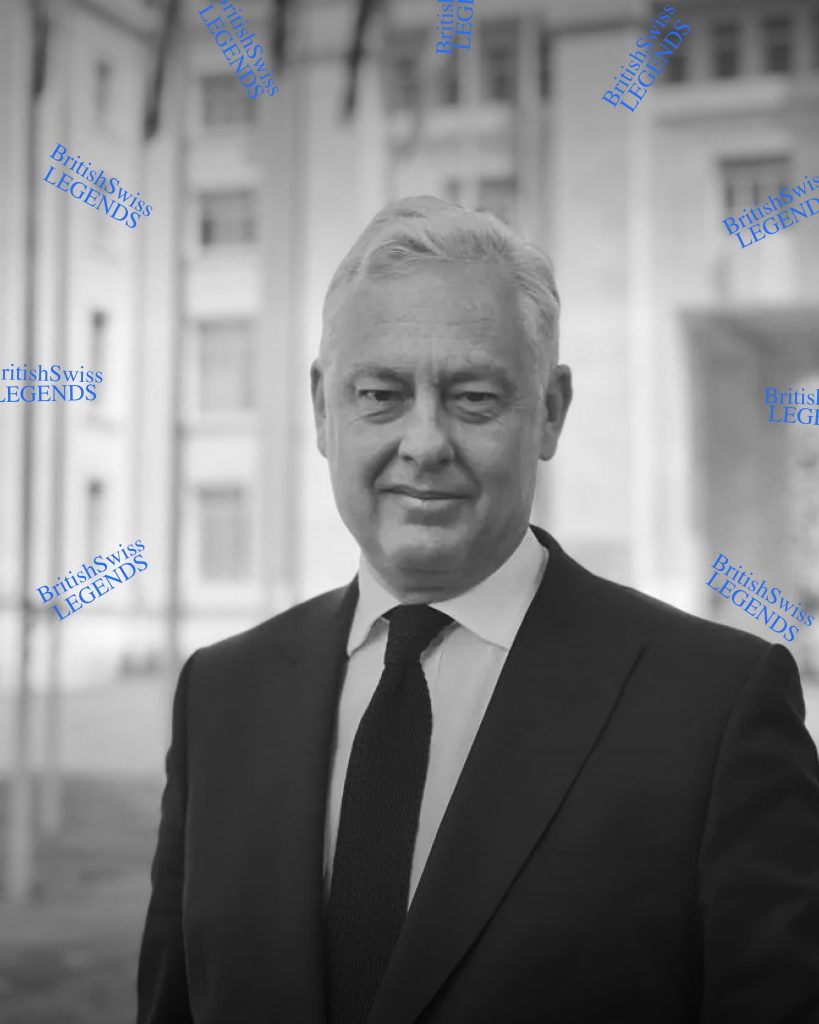
“Take long-term bets forged in the appreciation of where opportunities lie” Sir Simon Manley, KCMG
At a time characterised by international withdrawal and governments pivoting inward, Geneva remains one of the world’s great exceptions. Switzerland’s “international city” continues to be a hub for organisations, NGOs and charities that aim to have a positive impact around the world.
It can be said that very few individuals embody the values of collaboration and internationalism more than Sir Simon Manley, the former UK Ambassador to Spain and permanent representative to the United Nations and World Trade Organisation in Geneva. During his time in Switzerland, from 2021 to 2025, Manley successfully navigated the tight-knit diplomatic circles and large multinational bodies that make Geneva what it is today.
His term coincided with various crises that challenged the international community like never before, from pandemics and famine to war. While the world began to question the efficacy of the world’s international institutions, Manley was able to use what he called an “extraordinary ecosystem” to find real and lasting agreement between nations.
An accidental diplomat
Manley openly admits that he didn’t aim to become a diplomat, telling us that he “joined the foreign service by accident, to be honest.” “I thought I was going to be an academic, teaching French history at an obscure university.” Nevertheless, following an education at Oxford and Yale, Manley joined the Foreign and Commonwealth Office (FCO) in 1990, beginning 35 years of service.
But even though he was now ensconced in the British diplomatic world, it took a “feisty Scottish PA” to finally convince him to become an ambassador. Initially, Manley developed a specialism for multilateral jobs, serving once in the United Nations in New York and twice with the European Union. His first ambassadorship came in 2013, when he was made the UK’s representative in Spain.
“[Spain was] a curiously high-profile job”, Manley reflected, adding that much of his time in the office was spent “meeting hundreds of different people” in a week, managing Spain’s tricky relationship with Gibraltar, and securing the deal that guaranteed free movement to and from the British territory following Brexit.
Then, after serving as the FCO’s Director-General for COVID-19, Manley began his time in Geneva as the UK representative to the United Nations and World Trade Organisation.
Manley in Geneva: Transition amid COVID and Brexit
As Manley’s arrival coincided with the COVID-19 pandemic, it was inevitable that his initial work focused on trying to curb the spread of the virus worldwide. It was here that he worked on the landmark WTO deal that waived certain IP rights of vaccine providers to help speed up the production and distribution of COVID vaccines.
Manley was there “in the dying moments” of negotiations, resulting in a deal which meant more people around the world were vaccinated against the disease faster, while upholding the IP rights that had proved so crucial for the development of those vaccines in the first place. He was also one of the forces behind the World Health Organisation’s Pandemic Agreement, which is designed to make the world better prepared for the next global contagion.
Elsewhere, Manley sought to maximise the post-Brexit role of the UN in Geneva, as the UK took up its independent seat at the WTO and developed its own distinct voice on trade policy – in close partnership with the EU, nurtured a new agile and collaborative role for the UK in the UN, and secured a UK head for Europe’s world-leading particle physics laboratory, CERN.
A diplomat’s view of “International Geneva”
Looking back, Manley describes Geneva as a “unique ecosystem.” “There’s something very precious about Geneva that you don’t find in New York”, he noted, explaining that the city remains a healthy hub for NGOs and governments to interact in.
“Switzerland doesn’t get the credit it should for the role it plays as the host of this extraordinary ecosystem of Geneva. It is a genuine service to the international community.”
But it wasn’t all sunshine at the end of Lac Léman. Manley’s tenure saw what he calls an “explosion of conflict”, from the full-scale Russian invasion of Ukraine, to the Sudanese Civil War and the conflict in Gaza. He worked closely with the UK’s allies across multilateral Geneva, successfully leading the efforts to oust Russia from its elected leadership roles across the UN.
“That collaboration between us transformed us”, Manley explained, adding that while they were successful in reducing conflict in parts of the world, “we didn’t solve everything.”
“It was not in Geneva that you were going to end these conflicts, but it was in Geneva where you could try and ensure 2 things, one that you can recall the abuses that were being carried out, and secondly, of course…the scale and pace of those conflicts, created [the requirement to address a] tsunami of humanitarian need.”
For him, one of the “great gifts” of his career was being able to master not just language but culture. He noted that the most “impressive leaders are those who think long term” and can “take bets forged” in not just a mastery of culture but in “an appreciation of where opportunities lie.”
The future of International Institutions
Looking ahead, Manley predicted that there will be many “tough decisions” ahead for Geneva, the UN and international organisations as a whole, especially amid the scrapping of USAID and the reduction in international aid funding from other nations.
“One of my main worries is that budgetary cuts may lead to a breaking point.” “You can talk about a billion here and a billion there, but fundamentally, when you are talking about someone in a refugee camp in Syria or Bangladesh, who is not going to have the same level of support as they had last week and last year,” he noted.
How the relationship between the UK and Switzerland, the EU, America and the rest of the world evolves will also be crucial in the coming years.
However, Manley remains an optimist. “Despite the geopolitics of the last few years, I saw in Geneva that we actually managed to find agreements.” He added that despite the increased isolationism of the world, there is still “no substitute for collective action.”
As for what the future holds for “fragile but genuine” Geneva, and for the future of Sir Simon Manley’s career, only time will tell.