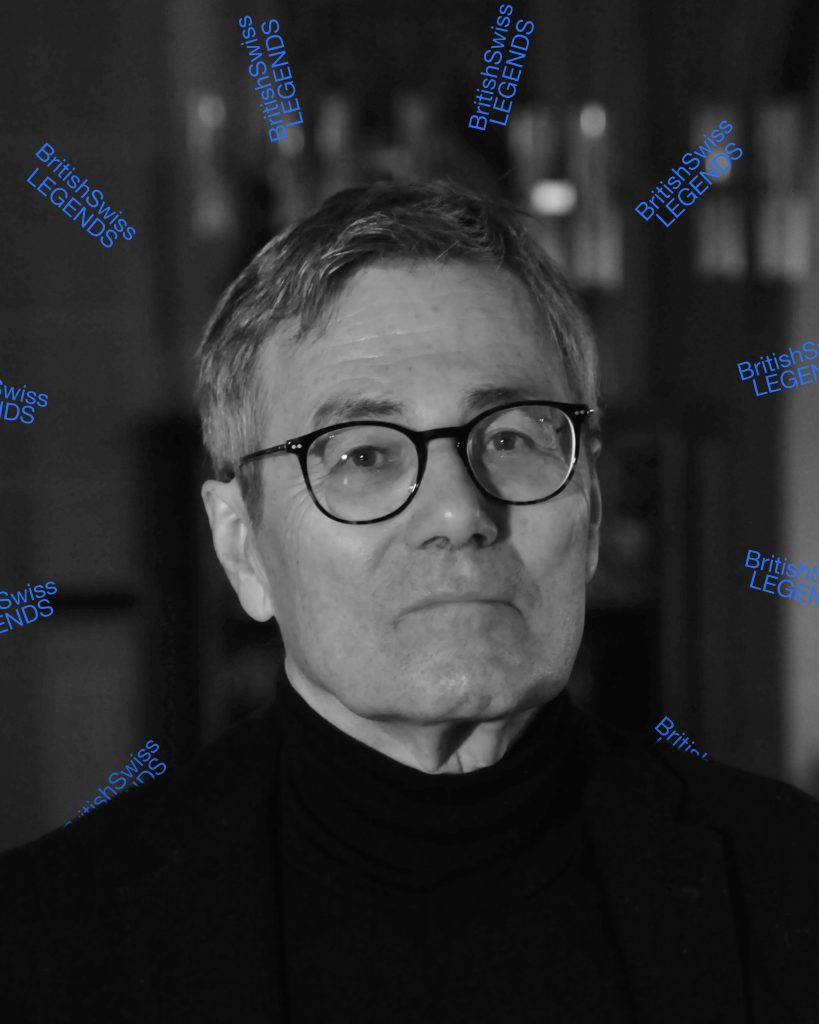
One of the most wonderful aspects of British musical culture is the many church choirs that call the country home. Whether you attend church regularly or just pop in for the Christmas carols, no one can deny the beautiful power that choral music can evoke.
Whilst most people are familiar with one or two hymns, many are unaware that some of the most moving and beautiful choral works of recent years were composed by a man from Switzerland: Carl Rütti.
Honing his craft
Born in 1949 in Fribourg, Carl Rütti’s connection with the United Kingdom came straight from birth, as he was named after the then-Prince Charles. He spent most of his early life studying at the monastery school in Engelberg, where he discovered his love for all things music. By the 1960s, he began to specialise in organ, piano and jazz music.
To hone his craft further, Rütti came to Zürich to study at the Conservatory of Music under Erich Vollenwyder (organ) and Sava Savoff (piano). By 1972, he had begun to teach piano at the same Conservatory and later became the organist at the Church of St. Peter and St. Paul in Oberägeri (Zug), a venue where he still performs today.
However, it was only a few years later that one decision would change his life forever and propel him into the annals of the great composers.
Inspiration and London Calling
“When I had completed my piano and organ exams in Zürich, my teacher advised me to go abroad. But where?” – “Oh, it’s everywhere the same, go wherever you like.” “So I asked my wife, and she said, Let’s go to London, as she was a language teacher and wanted to improve her English. I wrote a letter to Kendall Taylor, then the most famous professor of piano at the Royal College of Music, and much to my luck, he invited me to study with him.”
Affordable and vibrant: Music in 1970s London
Rütti’s career as a composer began in London in 1976. It was a time he describes as full of inspiration, but also full of happy coincidences. London and its concerts were relatively affordable, which allowed him to attend many different performances by a myriad of artists.
What truly propelled his musical fascination forward was listening to English choirs. “It was like a revelation to me. I was completely bowled over. Their singing was like playing the piano with human voices: 10 voices, as if playing a piano with 10 fingers.”
The style of choral singing in England was completely different from the singing on the continent. Unlike choirs in the rest of the world, British choirs are able to sing without vibrato and with absolute pitch accuracy. “This encouraged me to write music for English choirs with ten or more separate voices a cappella, without the risk of the voices becoming indistinguishable,” Rütti explained.
Filled with this enthusiasm for music, Rütti was ready to begin his career as a composer, yet the spark that set him on this path was a serendipity that was as ideal as it was Swiss:
He began composing because his neighbour, Mary, a flight attendant, was annoyed that Carl was waking her up in the early hours of the morning with his piano practice. Instead of practising, he therefore got up at 7 am and composed at his desk.
A composer driven by inspiration
In those early morning hours, he began writing on his first major work, Buch der Bilder (Book of Images): seven motets based on poems by Rainer Maria Rilke – set to images by Peter Wullimann – for a 10-part a cappella choir. It was recorded in 1978 by the Brompton Oratory Choir and later by the BBC Singers.
Back in Switzerland, Rütti remained prolific in composing music. He received commissions for all manner of musical genres: Brassband, Alpenhorn, organ, choir, orchestra, and so on.
But how does he tackle such a challenge?
“When composing, inspiration is the most important thing. I have to open my eyes, my ears and my mind. I have to ask myself what the work is actually meant to be,” he explained.
“That can happen very quickly, as with my first three Christmas Carols, I wonder as I wander, O little town of Bethlehem and Tomorrow shall be my dancing day, all of which were written in just three days. But a project can also keep me very busy for several months, as was the case with the Requiem, which was composed for The Bach Choir in 2007.”
His greatest inspiration has always been his wife, Marie-Louise. The two met after she saw him perform Rhapsody in Blue at a concert. Shortly after the performance, she wrote a letter, they met, and the rest, they say, is history.
What Rütti’s English composer colleagues called the “Nobel prize for composition” came about when Sir Stephen Cleobury commissioned Carl to compose the annual new Christmas Carol for the 2014 Festival of Nine Lessons and Carols. This was premiered at the Christmas service in King’s College Chapel and broadcast worldwide by BBC Radio and TV.
As for what the future holds for Carl Rütti: “There is no greater joy than returning to the UK again and again, for example, for a BBC Carol service last December at Temple Church, London, or this coming November for the world premiere of my work – still in progress! – Panta Rhei for choir and orchestra, commissioned by Nottingham Harmonic Choir. Returning to England is always like coming home.”