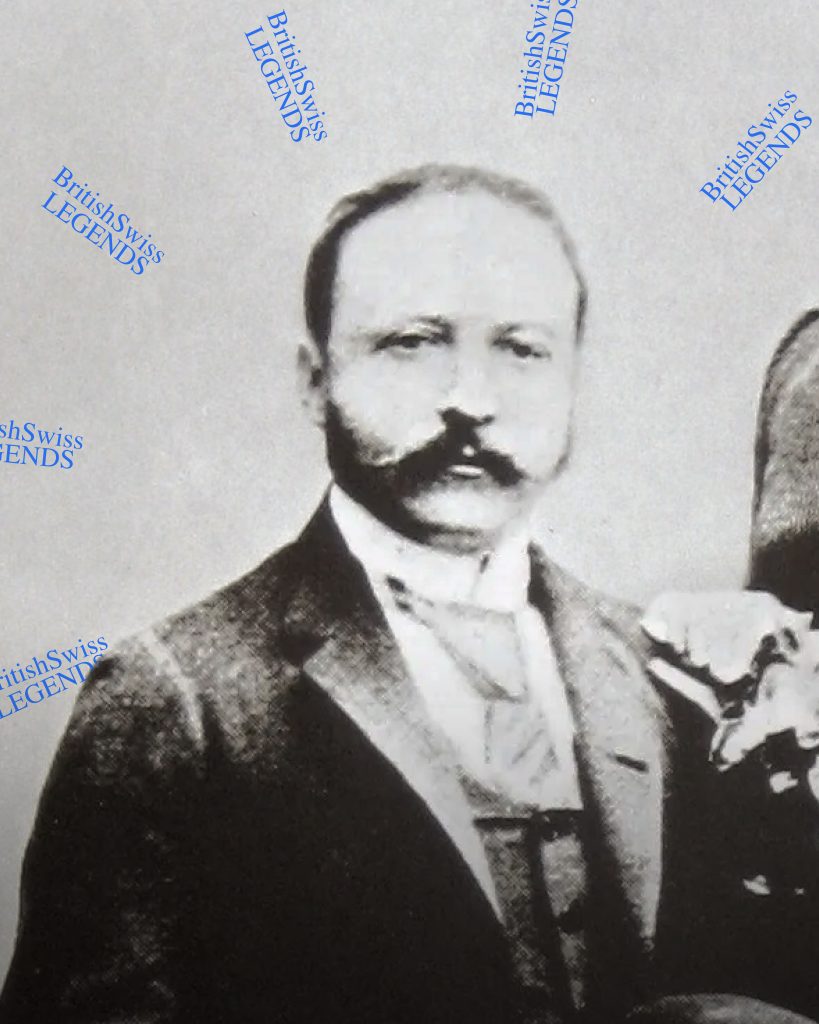
A napkin perfectly folded, a need satisfied before you even ask, a spotless room that makes the aches of travel disappear — this is the experience that César Ritz pioneered for guests around the world. From humble beginnings in Canton Valais, Ritz rose from Parisian waiter to the manager of Europe’s finest hotel empire. There’s a reason King Edward VII called him “the king of hoteliers and the hotelier of kings.”
Cornelia Ritz Bossicard, president of the César Ritz Foundation Niederwald, explains, Ritz possessed an extraordinary instinct for hospitality: “He was a visionary… and he had the ability to really understand the guests. For him, the fact that the guests were feeling good was what he valued most.”
Where fashion sits, putting on the Ritz
In 1898, the first-ever hotel to bear César Ritz’s name opened in Paris. It wasn’t long before the jewel-encrusted elite of Europe flocked to stay at the hotel, from Rothschilds and Rockefellers to Marlene Dietrich and the British Royal Family. In 1906, this opulence finally came to London, with the opening of the Ritz Hotel on Piccadilly. In the UK, the name Ritz became a symbol of wealth and opulence, a reputation it maintains today.
The opening was the peak of Ritz’s life, making him the very first and last word in luxury. But beneath the glamour, movie stars and monarchs, there was a humble, hard-working man whose care and attentive methods became the backbone of what we expect of hospitality today. For Ritz, the philosophy was simple: “He always said the guest is king.”
Humble beginnings and Parisian escapes
César Ritz was born in 1850 in the town of Niederwald, Canton Valais, as the youngest of 13 children. He grew up the son of mountain farmers, and after school, he started training as a sommelier and wine waiter in Brig at the age of 14.
Life in the Goms valley was far removed from the luxury he would later create. As Ritz Bossicard notes, “He was the 13th child of a farmer’s family… it was a very, very tough life.”
Even at this stage, the young Ritz did not appear destined for the high life of Paris and London, as his manager quickly sacked him. As Ritz Bossicard recounts, “his boss very soon told him, ‘You will never make it. You’re completely useless.’”
With Switzerland not offering the breakthrough he needed, in 1867 Ritz went to Paris to seek his fortune.
The Paris of the late 1860s and early 1870s was a city beset by war and revolution, but also by excitement, luxury, style and lofty minds. Ritz spent five years in this melting pot, learning his trade in the city’s finest restaurants. It was here that he met the elite of Europe and slowly began to form the philosophy that would transform him into the world’s greatest hotelier.
After stints in France and Austria, his meteoric rise truly began while managing the Rigi Kulm Hotel in Canton Schwyz in 1873. According to Max Alphons Pfyffer, the designer of the Grand Hôtel National in Lucerne, on one frigid winter day, 1,798 metres above sea level, the hotel’s central heating broke down just as a group of 40 guests were heading for lunch.
Faced with shivering, angry guests, Ritz sprang into action. He changed the menu to hot dishes, moved the tables into a smaller room for more heat, and heated 40 bricks in the oven. As Ritz Bossicard recalls, “Guests were cold, there was no heat. But with the bricks they were actually kept warm.” It was a legendary moment in hospitality history.
It was this feat of ingenuity that eventually saw him given charge of the Hôtel National. After periods in cities across the continent, in 1898 he opened Le Ritz in the Place Vendôme in Paris.
Luxury redefined
At his hotels, Ritz created a new form of luxury for the elite of Europe. Up until the 1870s, the luxury hotel experience was modelled on noble manor houses and the people who lived there. As a consequence, the atmosphere was rich, but familiar, stuffy and old-fashioned.
Ritz revolutionised what guests expected at hotels. “He recognised very early on that guests were expecting more and more comfort,” Ritz Bossicard explained.
His focus on hygiene saw Le Ritz in Paris become one of the first hotels in the world to have central heating in all rooms. It was also among the first to offer en-suite baths in every room, electric lighting and telephones. He even insisted that all fabrics in his hotels could be washed.
Thanks to his relationship with famous chef Auguste Escoffier, Ritz also put forward the idea that restaurants should be an integral part of the hotel experience. At his hotels, he transformed eateries from practical dining halls into destinations in their own right.
What truly set him apart, however, was his dedication to the idea that the customer was always right.
“See all without looking; hear all without listening; be attentive without being servile; anticipate without being presumptuous. If a diner complains about a dish or the wine, immediately remove it and replace it, no questions asked,” he once wrote.
Taking care of guests, but not himself
Sadly, Ritz’s star burned too bright for his own good. So captivated with bringing luxury and comfort to his guests, César Ritz failed to take care of his own comfort. At the age of just 53, Ritz suffered a mental breakdown that would end his public career. Experts today might diagnose him with chronic burnout.
Ritz spent his remaining days in a private clinic in Küssnacht am Rigi, Canton Schwyz. He passed away in 1918 — a premature end to a star-studded career.
Ritz: A seismic impact
Today, the glittering rooms and soaring foyers of the Ritz still captivate the imagination. Though the clientele walking its marbled halls are different, the luxury, service and style remain — a better monument than most figures get.
His legacy is perhaps best summarised by the remarkable journey he took. As Ritz Bossicard reflects, “He came from a small village in the Goms, went out to discover the world, redefined hospitality and always wanted to become better and better.”
Today, the César Ritz legacy lives on in the various hotels that he founded, which remain some of the best in the world. His work is still used as case studies for businesses around the world, and his name is given to one of the best hospitality schools in Switzerland.
In all, César Ritz was a defining figure of the Belle Époque era, combining taste, fashion, care, consideration and service into a cocktail of excellence.
For if you’re blue, and you don’t know where to go to, why don’t you go where fashion sits?
Now and forever, that is the Ritz.