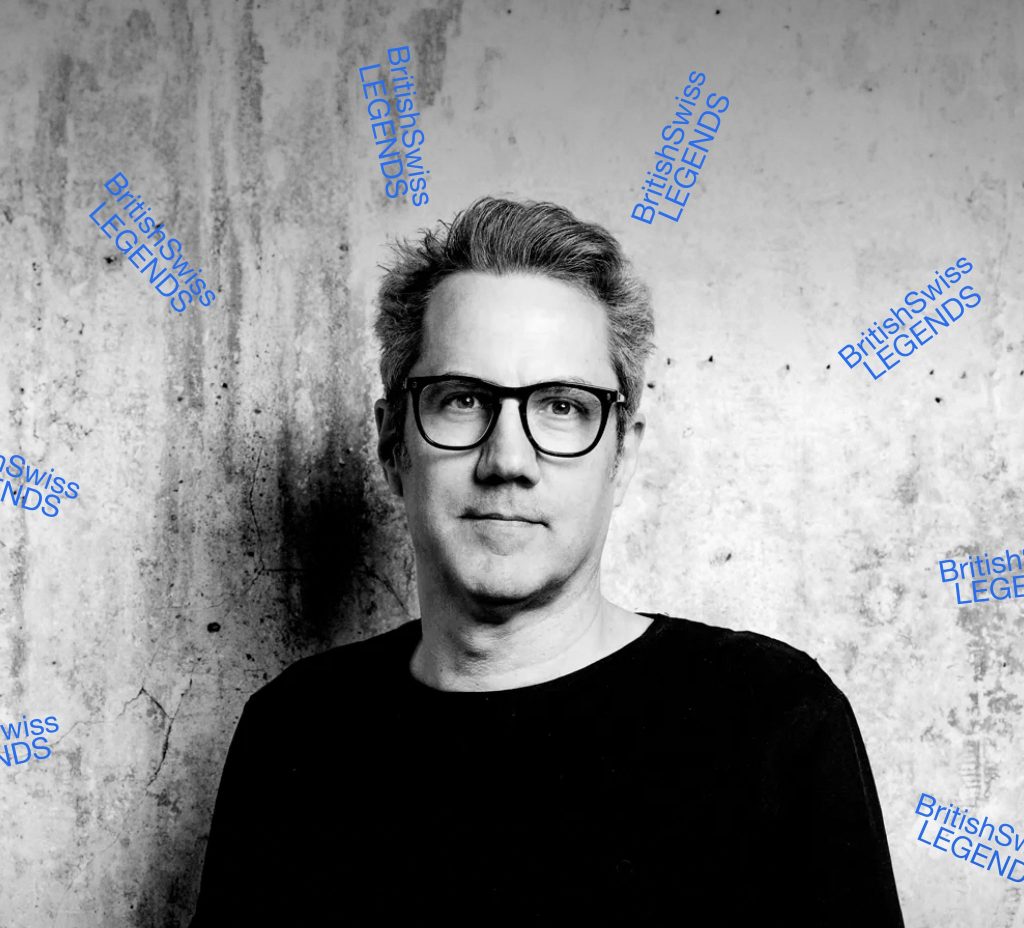
Nicolas Bonard is among a rare category of leaders who are able to operate and react fluently across cultures, industries and eras.
Bonard, Swiss by parentage but shaped by an adolescence in London, has been responsible for dramatically expanding the reach and securing the future of one of Switzerland’s most important events: the Montreux Jazz Festival.
Behind this success lies a man trained and seasoned in the world of global media, who successfully rode the waves of change in the 1990s to some of the top brands, from the NBA to MTV. But the journey to the top of his field started in the 1990s, in a press office in Montreux.
Early beginnings and the marriage of music and technology
Since growing up in London, Bonard’s fascination was “always about music or entertainment,” he told us.
This fascination came to a head in the 1990s, when Bonard worked summer jobs at the Montreux Jazz Festival. His family had known Claude Nobs, the founder of the festival, and the experience gave him a window into the industry, which he would eventually help shape.
Even in the 1990s, a world before social media, content production and viral trends, Bonard noted that “innovation was always a part of the [Montreux Jazz] Festival, and Claude Nobs’ DNA.” Early on, the festival was always experimenting with artists’ kiosks and exhibits hosted on Apple computers. Journalists were also able to retrieve artitst photos and biographies digitally, something that was “quite innovative” and radical at the time.
Bonard reflected that this was the first proof for him that music, culture and technology could and should work together. But like many who strive for a creative role, Bonard started by taking what he described as the sensible path: a corporate one. However, this did not last for long.
Shaping media in a time of flux
In fact, it was a chance meeting over dinner which set Bonard on his career. A friend had told him that the European arm of the American National Basketball Association was looking for someone, and after an interview, he found himself working in sports entertainment.
Bonard’s story fits neatly among the trends of the time. In the 1990s, media and sporting rights were exploding across international and satellite television platforms, and new technology allowed providers to set up multiple channels. Through his work at the NBA, Bonard became an expert in global media economics, broadcast rights and IP.
Having seen the power of bringing NBA stars like Michael Jordan to Paris, Bonard also discovered the power of content to drive industries.
Having embedded himself in the entertainment industry of the 1990s, Bonard then went to the organisation that is arguably the biggest symbol of the era: MTV. Bonard said the place was the “coolest place to work”, and deepened his understanding of the music world and the impact the media has on it.
Though the position would see him based in London, Bonard never forgot the city where he first plied his trade. According to Bonard, Claude Nobs would occasionally call for advice, especially when it came to deals and partnerships.
Future-proofing Switzerland’s greatest festival
However, what truly cemented Bonard’s career came following Claude Nobs’ death in 2013. He noted that after his passing, Montreux faced a new reality: touring had become an integral part of an artist’s revenue, as high as 80 percent in some cases, as streaming began to impact record sales. Performance fees skyrocketed, which severely impacted festivals in Switzerland.
Having joined the festival’s advisory board, Bonard noted that “very quickly it became apparent that we had to kind of future-proof the festival.” He discovered that with artists more reliant than ever on festivals, their negotiating power would increase.
He also saw the huge potential in new media as a means of future-proofing the festival. The Montreux Jazz Festival possessed an audio-visual library of 8,000 recorded concerts that were barely used commercially. In 2018, he decided to take a step into the unknown, creating Montreux Media Ventures to monetise and distribute audiovisual and audio content globally to supplement the festival and reach new and younger audiences.
Montreux, COVID and impact
Things kicked into high gear at both the worst and best times. During the COVID pandemic, which shut concerts worldwide, Bonard faced a choice: “We either roll up in a corner and let the storm pass, or we try to do something.” They chose the latter. Montreux began live-streaming concerts on YouTube for free. The objective was not immediate monetisation. “It was all about reach. It was about reach, notoriety — reach, reach, reach.”
The idea worked, with sponsors satisfied and artists enthusiastic about the production value. Bonard and his team pioneered filming techniques, designing them for digital and mobile phone use. He did this with stylistic directness and fluidity.
Today, the Montreux Jazz Festival is broadcast worldwide. Its YouTube channel impacts millions annually, and its audiovisual archive was inscribed by UNESCO in 2013. In this way, Bonard has done his part to make sure that festivals both past and present are available for the public to enjoy.
Reflecting on his success, Bonard said that he “would have probably have taken a different path”, adding that it took him time to realise that his strengths did not lie in the rigid structures which define the corporate world but instead aim for a role which gave his ideas room to breathe.
“What I do is not a job,” he concluded. “I’m lucky I can make a living out of it.” In all, he concluded that his approach is direct and efficient; “come up with an idea, and I can execute it.”