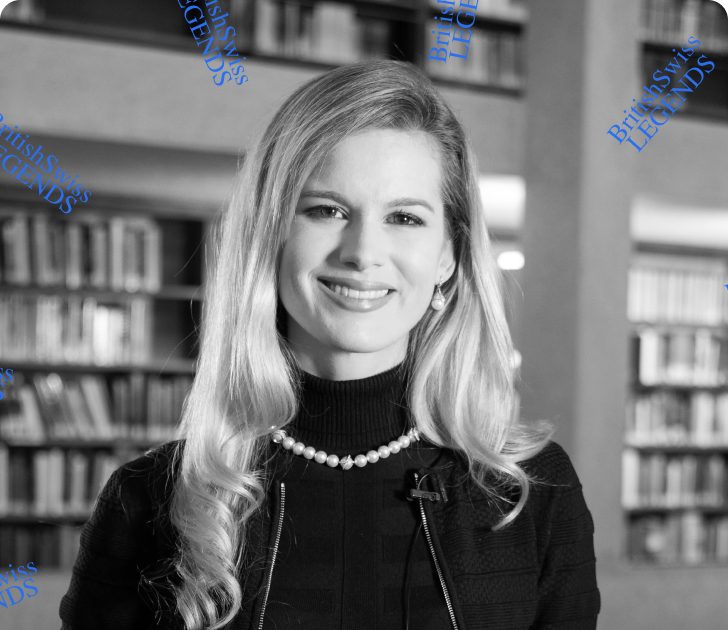
In an era consistently defined by technological innovation, geopolitical complexity and global health challenges, it can be said that Dr. Carina Tyrrell stands at the centre of this brave new world.
The physician, investor and institutional leader has led in Switzerland, the UK and beyond, translating discovery, capital and innovation into durable impact.
Grounded in rigorous academic training and medical expertise, Tyrrell has reached beyond a single role or sector, becoming the point where innovation, global health, tech-ventures and capital meet.
Inspiration in Geneva
Born in Geneva, Tyrrell noted that her early inspirations were her parents. “My mother built her career leading at the intersection of global health and international funding at the World Health Organisation. My father worked as a particle physicist at CERN, at the frontier of discovery, helping translate fundamental science into technologies that shaped the modern world,” she told us.
Growing up in the heart of international Geneva, Tyrrell quickly encountered some of the world’s great institutions, including the World Health Organisation and CERN – where the World Wide Web was first developed. “Growing up in that environment, and later meeting Sir Tim Berners-Lee, shaped my earliest understanding of how fundamental science can transform society.” “I understood that ideas only matter when they are translated into real-world impact.”
This experience translated to her time at the University of Cambridge, where she trained in science and as a physician with a focus on global health. “At Cambridge, I saw that pattern again,” she reflected. “Institutions there did not simply produce research — they built technologies that underpin modern society, such as ARM, whose chip architecture powers much of global computing.”
Global health and the impact of capital
Tyrrell continued to work in medicine and, during the COVID-19 pandemic, was instrumental in helping deliver the Oxford-AstraZeneca vaccine and was featured on the front page of The Times. With her expertise in global health, she helped the University of Oxford analyse data from hundreds of vaccine and treatment trials all over the world.
“It demonstrated what becomes possible when capital, science, policy and execution are aligned around a shared objective. It required shaping real-time strategy, and alignment of capital and partners to move rapidly from emerging evidence to funding decisions and large-scale deployment,” she explained.
It was during this experience that she realised that the field of global health is not just pushed forward in the lab. “I recognised that capital is the decisive force that determines whether ideas move or stall,” she told us.
This realisation shaped the next phase of her work. While continuing to serve as a Fellow of the University of Cambridge and a Board Governor of Cambridge University Hospitals NHS Foundation Trust, and publishing work in global health, Tyrrell also moved into institutional finance and venture investment.
She began this work at Goldman Sachs in London, before later serving as Chief of Staff and Investor to both the former President of Samsung and CEO of Intel at Walden Catalyst Ventures. Tyrrell is a Venture Partner at Black Opal Ventures, a venture capital fund investing in frontier technologies and global health innovation.
“Today, my work centres on raising, allocating and deploying capital to translate strategic ambition into global impact,” Tyrrell noted. She operates at the intersection of science, finance and strategic institutions, aligning capital, partners and execution to translate breakthrough technologies into real-world impact.
Success in enabling others to succeed
Whereas she used to define success in academic terms, today she sees it in “enabling others to succeed – building platforms and institutions where talented people can do their best work.”
Through her work with leading technology family offices, Tyrrell came to believe lasting impact comes not just from individual investments, but from improving how capital is deployed – through clear priorities, governance and long-term partnerships.
She also noted that “scientific strength alone does not guarantee real-world impact.” Many initiatives with strong science struggle to scale when markets and capital are not aligned, which is why she focuses on aligning capital, partners and execution so breakthrough technologies can scale.
Switzerland and the UK in innovation and capital
Despite working across the world, Tyrrell still considers the UK and Switzerland a “natural centre of gravity” for her work. “Both countries combine world-class science with serious capital and global reach.” She admires the UK for its comfort in experimentation, and Switzerland for its focus on long-term capital and precision. “The UK is exceptional at inventing the future, and Switzerland is exceptional at ensuring it lasts. Together, that combination is unusually powerful.”
She added that when working together, both countries can provide world-beating innovations in life sciences, especially when UK research capacity is paired with Switzerland’s world-leading life sciences companies.
For those looking to build ties between the UK and Switzerland, Tyrrell argued that trusted partnerships and relationships are integral. She hoped that in the future, Switzerland will embrace what she calls the “UK’s relationship with the sea…a culture that is outward-looking, curious and comfortable exploring”, while the UK could benefit from Switzerland’s relationship with the mountains – a culture of precision, resilience and long-term thinking.
Tyrrell and legacy
For her, her impact has been shaped by the so-called Four Agreements: “being impeccable with my word, not taking things personally, never making assumptions, and always doing my best.”
“The biggest opportunities, and the most meaningful careers, tend to come from working at the intersection of disciplines. If you combine depth of knowledge with the ability to work across systems and bring people together around long-term outcomes, you can create change at a scale that goes far beyond any individual,” Tyrrell concluded.