“Do nothing in haste; look well to each step, and from the beginning think what may be the end.” – Edward Whymper (Scrambles Amongst the Alps)
When talking about Switzerland, it isn’t long before the conversation is steered towards the Alps. The mountain range is synonymous with the country, being the source of much of its natural beauty, culture and economy.
Though it is awash with symbolic peaks, no other mountain is as famous as the Matterhorn. Standing at 4.478 metres above sea level, the peak separating Switzerland and Italy has remained undisturbed since it sprang from the hillside 60 million years ago.
That was until 1865, when a team of intrepid explorers finally conquered the mountain. It was an exciting, groundbreaking, but deadly expedition, all led by a man from London.
Mountain climbing’s golden age
Edward Whymper’s ascension of the Matterhorn marked the end of the Golden Age of Alpinism. This period began in the mid-19th century when a team of British climbers scaled the Wetterhorn near Grindelwald. As Adam Butterworth of the Alpine Club explains, it was “when many of the most significant peaks in the European Alps were climbed for the first time.”
Butterworth notes that the timing of this boom was not accidental. “One of the key explanations as to when it began is the expansion in rail travel, which made journeys to the Alps more practical.” With improved access to the mountains, wealthy travellers with the time and resources began making their way south in increasing numbers.
Though many Victorian alpinists used “science” as an excuse to scale the Alps, in most cases, it was sport, prestige and glory that drove them on. That’s why it was common practice for mountaineers to add to their already heavy packs with bottles of champagne, which they would open and drink once they reached the summit.
“By the end of the ‘Golden Age’, attitudes had changed somewhat, and mountaineering was seen more as a physical, sporting undertaking rather than a scientific one,” Butterworth explains.
Unlike 19th-century explorations of the seas, Arctic and Antarctica, these new Alpinists did not benefit from new technology. Most made the journey with simple, often homemade and improvised equipment, from wool and flannel layers to primitive ice axes and hand-spun hemp rope.
Despite their primitive tools, as the years went on, all of Switzerland’s major peaks were summited, from the Dufourspitze – the country’s highest mountain – in 1855, to Mönch (1857), Eiger (1858) and Weisshorn (1861). By 1865, only one major mountain was left to summit, the Matterhorn.
As Butterworth describes it, the peak was widely seen as the “last, great problem” of the Golden Age.
However, as it towered over the alpine village of Zermatt, Swiss locals warned against climbing the mountain, claiming that it was at best impossible and at worst the domain of evil beasts and spirits. That did not deter Whymper, with his story becoming one of great glory, but also of tragedy.
Whymper and the Matterhorn
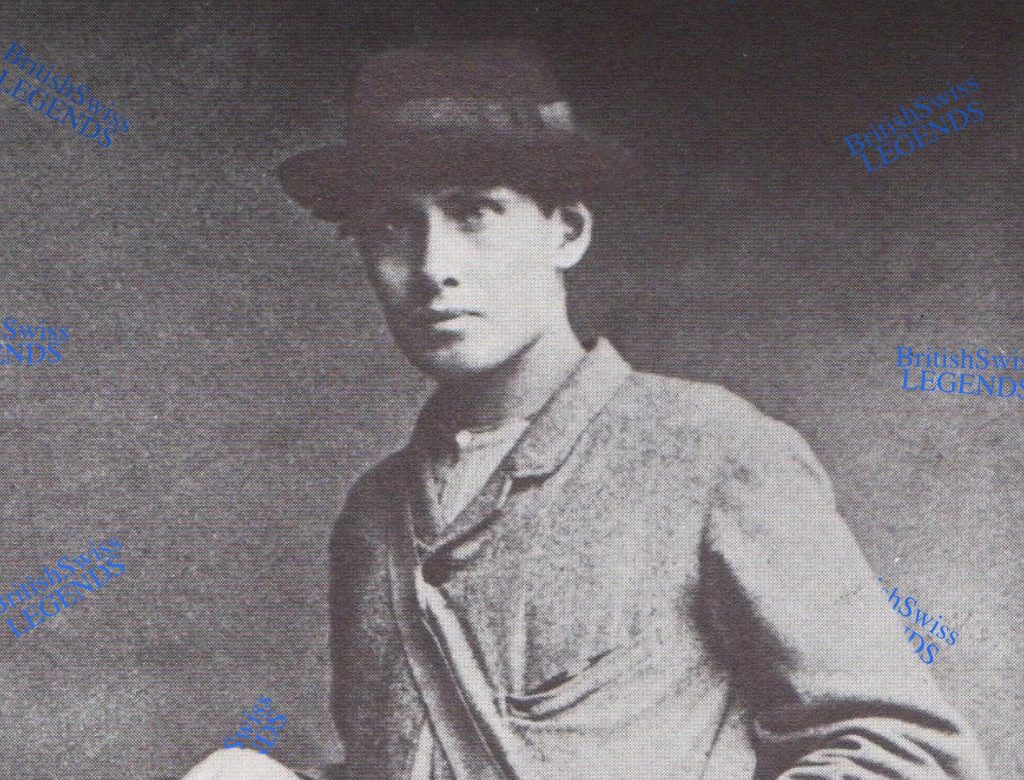
Born in London in 1840, Edward Whymper was the second of 11 children and originally trained to be a wood engraver. In 1860, he was sent to Switzerland to make a series of drawings and engravings of the Alps, and soon after began mountaineering. Unlike the champagne-popping Alpine explorers of old, Whymper’s focus was on science, ascending peaks so that he could draw the topography of the land from the summit.
Having climbed the likes of Mont Pelvoux and Les Écrins, Whymper set his sights on the Matterhorn. What made his ascents of the mountain all the more dangerous was the fact that they were races against fellow alpinist and physicist John Tyndall and Italian mountaineer Jean-Antoine Carrel.
Whymper’s first of seven failed attempts to ascend the Matterhorn began in 1862. During these climbs, each team attempted to scale the Italian side of the mountain, but to no avail. The cliffs were too steep, the ice walls too impassable, and the obstacles too menacing. That’s when Whymper made a decision which would sweep him into the history books.
Matterhorn conquered
In 1865, Whymper decided to try and ascend the Swiss side of the peak, ignoring the locals’ warnings of demons and ghouls. Armed with wooden pickaxes, hand-woven rope and cloth knapsacks, Whymper, two other British explorers, Lord Francis Douglas and Charles Hudson, new climber Douglas Hadow, French climber Michel Croz and two Swiss mountain guides, made the momentous climb on July 13.
By July 14th, the group ascended without ropes to 4.300 metres above sea level. After hours of brutal climbing, at 1,40pm, Whymper and Michel Croz arrived on the final snowy hill to the summit. Sprinting together, the two men became the first to ascend the Matterhorn.
He then peered down the hill to find the expedition by Carrel 200 metres below them; the race had been won. The last of Switzerland’s great mountains had been conquered, and after spending an hour on the summit, the group descended the icy peak.
Tragedy in thin air
This was when the devils of the Matterhorn claimed their last victims. On the way down, the inexperienced Douglas Hadow slipped and fell, falling into Croz and bringing the pair, Douglas and Hudson, down the cliff face. Whymper, and father and son Swiss guides Peter and Peter Taugwalder clung on for dear life as their colleagues slipped down the cliff, grasping the cold surface, trying desperately to stop the slide.
It was at this point that the rope connecting them all snapped, leaving Whymper and the Taugwalders shaken but safe. After hours of trying to find their fallen comrades, they continued the descent. On the way, Whymper reported that the fog of the valley below revealed a shape resembling an arch with two crosses. They reached Zermatt on July 15.
As Butterworth explains, tragedy has always been part of the sport. “Death and mountaineering have always gone hand in hand. There is an inherent risk to the activity that all mountaineers should acknowledge before tying into a rope.”
The accident also illustrates a sobering truth for climbers. “There is a common expression among mountaineers: ‘The summit is only the half-way point.’ It’s not enough to get up the mountain safely, you also have to get back down,” Butterworth adds.
Following his ascent of the Matterhorn, Whymper would go on to conduct explorations in Greenland, North and South America, from the Rocky Mountains to the Andes. In all, he was the first to ascend nine separate mountains, one of which, Mount Whymper in British Columbia, is named after him. He would pass away in Chamonix, France, in 1911, at the age of 71.
Whymper: Alpine pioneer and cautionary tale
Whymper, a lesser-known figure today, demonstrated that with skill, planning and courage, the seemingly impossible Alpine peaks could be summited. His groundbreaking explorations created a strong bond between the UK and Swiss mountaineering communities that endures to this day.
His writings about his adventures inspired budding mountaineers worldwide, and his accounts of his Matterhorn ascent served as a cautionary tale about risk and how to climb the world’s most dangerous peaks as safely as possible. Alpinist Leslie Stephen called him the “Robespierre of Mountaineering”, a nod to Whymper’s flair, innovation, strong will and single-mindedness.
But his ascent of the Matterhorn is not without controversy. The deaths of so many people on his ascent led to investigations in Switzerland and indignation in the UK. Some even suggested that Whymper had cut the rope to save his own life, an accusation which has never been substantiated.
In all, the story of Whymper and of the men who went with him is a symbol of the time when British explorers, with Swiss guides, pushed the boundaries of human exploration, endurance and endeavour. On the ridges of the Matterhorn, they wrote a chapter of human history that has never been forgotten.